

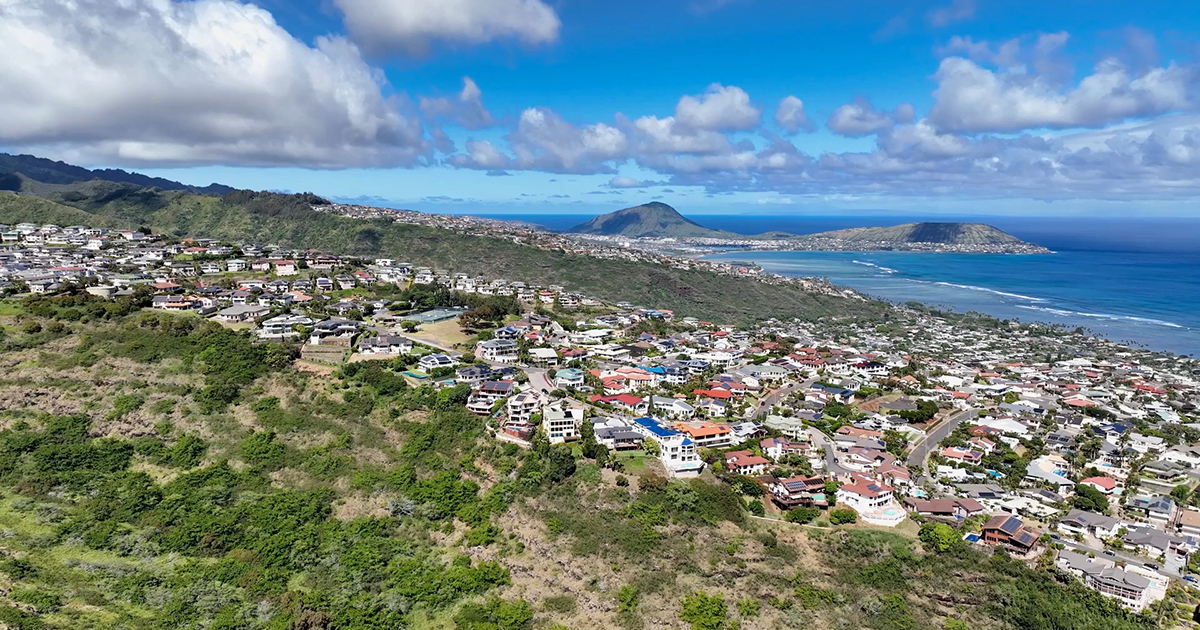
Living in Waialae Iki: An Oʻahu Neighborhood Guide
Waialae Iki is a residential hillside community in East Honolulu, positioned above neighborhoods such as Waiʻalae and Kāhala. Its elevated setting can provide sweeping views toward Diamond Head, the coastline and portions of urban Honolulu, along with a greater sense of separation from the activity below.
The ridge is known for custom homes, sloping lots and streets that climb toward the Koʻolau foothills. Those qualities can make Waialae Iki especially appealing to buyers seeking views and privacy—but they also make it important to investigate the specific lot, title documents, building restrictions, drainage system and retaining improvements before purchasing.
The first fact every buyer should understand is that Waialae Iki is not governed by one universal homeowners association or one neighborhood-wide set of rules.
How Waialae Iki is organized
Properties commonly described as being in Waialae Iki may fall within different development units or communities.
The Waialae Iki Ridge Community Association, generally known as WIRCA, represents Units II, III and IV. WIRCA describes its area as beginning beyond the first water tower on Laukahi Street and continuing up the ridge to—but not including—the separately governed gated community of Waialae Iki 5.
| Area | General governing structure | Publicly identified 2026 fee |
|---|---|---|
| Waialae Iki Units II–IV | Recorded private covenants, city laws and voluntary WIRCA membership | $425 annual WIRCA dues, voluntary |
| Unit III | General declaration plus supplemental building and view restrictions | No separate public fee identified |
| Unit IV | General declaration plus supplemental building and lot-specific view restrictions | No separate public fee identified |
| Waialae Iki 5 | Separate gated community association with its own governing documents | Current regular dues must be verified directly |
| Other nearby or lower-ridge properties | Parcel-specific title documents, zoning and possible CPR documents | Property-specific |
WIRCA is a voluntary community association rather than a mandatory HOA. Its 2026 dues are $425 per property, and security represents its largest operating expense. However, the recorded covenants affecting Units II–IV are separate from WIRCA membership. An owner does not avoid deed restrictions by declining to pay voluntary WIRCA dues.
Waialae Iki 5 is a separate gated community at the upper end of the ridge. Its public information describes controlled access through a staffed gate, community recreation facilities, tennis and pickleball courts, and a pavilion. Its governing documents, regular dues, assessments and architectural rules must be obtained from the association for the particular purchase.
Why the distinction matters
Two properties both advertised as being in Waialae Iki may have significantly different:
- Association obligations
- Building-height restrictions
- View-plane limitations
- Shared driveway or sewer responsibilities
- Architectural requirements
- Gate and contractor rules
- Regular dues and special assessments
Before relying on a listing description, buyers should identify the property’s tax map key, legal description, development unit and every recorded document listed in the preliminary title report.
What is it like to own a hillside home in Waialae Iki?
The ridge setting is a major part of Waialae Iki’s appeal. It is also why a buyer’s physical inspection should extend beyond the interior of the house.
Views and orientation
The view from one Waialae Iki property can be very different from the next. Elevation, lot orientation, neighboring vegetation, rooflines and the position of nearby homes all matter.
Units III and IV have private view-related restrictions, but those restrictions do not guarantee that a particular ocean, Diamond Head or city view will remain completely unobstructed. They regulate intrusions into defined planes; they do not create an unlimited right to every existing sightline.
A buyer placing significant value on a view should evaluate:
- Which rooms and outdoor areas receive the view
- Whether neighboring trees are within a protected plane
- Whether a vacant or under-improved neighboring lot could be developed
- Whether the subject property’s own expansion would be limited by a view plane
- How weather, sun exposure and nighttime glare affect the outlook
Slopes, retaining walls and drainage
On a hillside property, water management is a structural issue as well as a landscaping issue.
Some Waialae Iki parcels contain drainage easements, ditches or other systems that owners must keep repaired and unobstructed. The Unit III and IV documents also prohibit owners from obstructing established drainage patterns and require runoff to be collected, channelized or dispersed in a way that avoids erosion and damage to neighboring property.
A buyer should identify:
- Retaining walls on or near the property
- Cracking, movement, leaning or evidence of repair
- Drainage swales, catch basins and subdrain outlets
- Water arriving from uphill properties
- Areas of fill or clay soil
- Erosion or recurring moisture at foundations
- Maintenance agreements involving neighboring lots
Where conditions warrant it, a standard home inspection should be supplemented by a structural engineer, drainage specialist or geotechnical professional.
Driveways, parking and day-to-day access
Steep driveways and street grades are common hillside considerations. Buyers should test whether their vehicles can enter, turn and park comfortably and whether guests, service providers and emergency vehicles have practical access.
Units III and IV also contain private requirements involving garage placement, driveway slopes and driveway materials. For example, the recorded documents call for concrete driveways at slopes of 16% or greater in Unit III and 12% or greater in Unit IV.
In Waialae Iki 5, professional contractors and yard-service workers are admitted from 7:00 a.m. to 5:00 p.m., Monday through Saturday, and professional service work is not permitted on Sundays or observed holidays under the community’s published visitor rules.
Understanding the homes
Waialae Iki homes should be evaluated individually rather than through broad neighborhood assumptions. Remodel quality, permit history, drainage design, roof condition and retaining-wall construction can differ considerably from one property to another.
Important questions include:
- Does the physical configuration match approved plans?
- Were additions, decks, pools, garage conversions and retaining walls permitted?
- Is any lower-level space being used as a bedroom or separate unit?
- Is the reported square footage consistent across tax, permit and appraisal records?
- Are walls, fences, eaves or driveways located within easements?
- Does the house comply with the private height, coverage and view restrictions for its unit?
A beautifully renovated house can still present risk when the renovation history, private restrictions or site improvements have not been fully documented.
Rules buyers should know about
The general declaration covering Units II–IV limits lots to residential use and generally permits one single-family dwelling per lot. It also restricts further subdivision that would create additional building lots and requires structures and landscaping to be maintained.
Units III and IV have additional private restrictions. Depending on the unit and lot, these can include:
- An 18-foot private building-height limit
- Maximum lot coverage of one-third
- Minimum enclosed dwelling sizes
- Double-garage or carport requirements
- Garage setbacks
- View planes affecting buildings, trees and hedges
- Fence and wall limitations
- Drainage and grading controls
- Requirements affecting filled or clay soils
- Underground utility provisions
- Exterior color and glare controls
These private limits may be more restrictive than what city zoning would otherwise permit. A city building permit does not automatically eliminate a private covenant.
For a detailed explanation, see the companion article “Waialae Iki Building Rules: View Planes, Height Limits, ADUs and Renovations.”
Costs buyers should anticipate
Waialae Iki does not have one standardized cost sheet. Expenses depend on the property’s unit, association status, condition and title obligations.
Association and community expenses
For Units II–IV, voluntary WIRCA dues are $425 per property for 2026. Waialae Iki 5’s current regular dues and assessments should be established through the association’s current resale or disclosure package rather than inferred from an old listing.
Some properties may also be subject to private agreements requiring owners to share costs for:
- Roads or driveways
- Sewer lines
- Drainage systems
- Refuse areas
- Retaining improvements
- Other common facilities
The recorded documents for certain lots provide enforcement or lien remedies when a responsible owner does not pay an allocated share.
Property taxes
For Honolulu’s fiscal year running July 1, 2026 through June 30, 2027, the Residential rate is $3.50 per $1,000 of net taxable value. Residential A uses a two-tier structure: $3.50 per $1,000 on the first $1 million and $11.40 per $1,000 above $1 million. Classification depends on factors including use, assessed value and whether the property has a qualifying home exemption.
Qualifying owner-occupants may receive a $120,000 home exemption, increased to $160,000 for a qualifying owner age 65 or older. The city generally requires exemption claims by September 30 for the following tax year.
Insurance and natural hazards
Standard homeowners policies typically do not cover hurricane or flood damage. Hurricane protection may require a separate policy or endorsement, and flood coverage is separate. Buyers should obtain property-specific, bindable quotes while they retain applicable inspection and financing rights.
Oʻahu’s updated FEMA flood maps became effective June 10, 2026. A parcel’s flood classification can affect financing, insurance and future construction requirements. Honolulu’s Oʻahu Hazard Explorer can also be used to review mapped flood, wildfire, tsunami, dam and levee hazards by address.
A pre-offer checklist for Waialae Iki buyers
Before deciding what a property is worth, buyers should try to establish:
- The exact unit and governing documents. Confirm whether the property is in Unit II, III, IV, Waialae Iki 5, a CPR or another title arrangement.
- The realistic renovation envelope. Determine the applicable private height, coverage, setback and view-plane restrictions before assigning value to expansion potential.
- The condition of hillside improvements. Inspect retaining walls, foundations, drainage systems, slopes and areas of fill.
- The complete permit history. Compare the house as built with approved plans, tax records, the survey and the seller’s disclosure.
- All recurring and contingent costs. Confirm dues, assessments, shared-maintenance obligations, taxes, utilities and insurance.
- The intended use. Obtain professional advice before assuming the property can support an ADU, separate rental area, short-term rental, major home business or condominium-property regime.
Is Waialae Iki the right neighborhood for you?
Waialae Iki can be an excellent fit for a buyer who values hillside living, views and convenient access to East Honolulu. The best purchase, however, is not necessarily the house with the highest elevation or broadest view. It is the home whose title, physical condition, building limitations and ownership costs align with the buyer’s actual plans.
The neighborhood rewards careful due diligence. Buyers who identify the precise unit, read the recorded documents and investigate the site before closing are in a much stronger position to enjoy the benefits of ridge living without discovering unexpected limitations later.
Planning a Waialae Iki home search?
Susan Borochov is a Honolulu REALTOR® with Coldwell Banker Island Properties and holds the ABR, CRS, CHMS and GRI designations. She can be reached at 808-478-0330.
This article provides general public-record information as of July 12, 2026. It is not legal, tax, title, architectural, engineering or insurance advice. Rules and fees can change, and the documents recorded against the individual property control.